
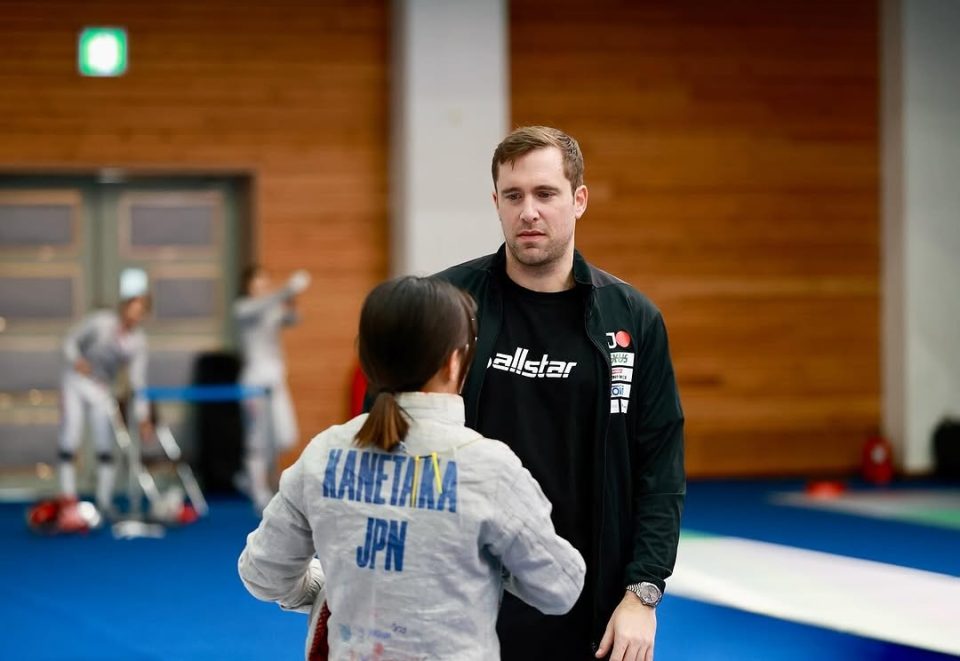
Frenchman Jerome Guth, currently the head coach of Japan’s men and women sabre teams, has spent nearly two decades coaching across France, the United States and Japan.
Speaking to SAI Media on the sidelines of the Senior Asian Fencing Championships 2026 in Bharat Mandapam, New Delhi.
For the Frenchman, his first visit to India has left a positive impression, both on and off the piste.
“This is my first time in India. I’ve never come here before. We are very pleased with the organization. Everything since we touched down in Delhi, the hotel, the shuttles, the organization of the competition, the timing, everything is very well organized for performance. This is good for us,”
Guth said.Jerome Guth, who’s guided his sabre team to claiming four podium finishes across four sabre competitions- gold in women’s sabre, silver medals in men’s and women’s team sabre events as well as bronze in men’s sabre- from the New Delhi competition, believes India has already shown encouraging signs of progress despite fencing remaining a niche discipline.“India is still an emerging country in terms of sabre,” Guth, 41, told SAI Media.
“Over the past 10 years there has been one very good women’s fencer, Bhavani [Devi], who was at the [Tokyo] Olympics. I know her very well because she is on the circuit and I see her very often.”
Referring to the rise of Olympian Bhavani Devi and the gradual improvement of Indian fencing on the international stage, Guth noted that the achievements have come despite the sport not enjoying mainstream status in the country.
“Fencing may not still be a major sport in India, I believe. However, I’ve seen them growing and achieving big results. These are big achievements. So, I only see them growing from here,” added the Frenchman.Guth’s confidence stems from Japan’s own transformation.
The Japanese Sabre team has clinched 45 International medals over the past 3-5 years. The Sabre team also qualified for the first time at the Olympics and clinched a bronze medal in Paris 2024.
“Don’t see why India wouldn’t be growing more in Fencing”Jerome Guth believes India’s true potential remains largely untapped.
“India is the country in the world with the most inhabitants, with the most people. So, it is hard for me to understand why the Indian team goes to competitions with only two or three fencers and not a full roster of 12,” he told SAI Media.
“More clubs and more structure of competitions for fencing are needed in different parts of India. With such a big demographic base, I don’t see why India wouldn’t be growing more,” the Frenchman added.
One of the most significant lessons from Japan’s rise, Guth says, was the willingness to look beyond traditional boundaries and bring international expertise into the system.
“Japan also came from very far. Fencing was a very small sport 15, 16 or 20 years ago. I think what helped was achieving a very big result at one point. After that, the government became willing to invest more money in the sport.
“For that, you need good coaches. You need to hire coaches. This is what Japan has done. Japan has hired a lot of foreign coaches because fencing is not traditionally a Japanese sport, just as it is not an Indian sport,” added the Frenchman.Asked what single factor changed Japan’s fortunes, Guth’s answer was immediate.
“Foreign coaches. This is what they did 20 years ago. They made a bet on hiring foreign coaches. This is my fifth season with the Japan team, so I’ve been there for around four years.”
“Grassroots development is also part of my job. Many of my colleagues around the world don’t do that, but I understand how valuable it is and that I need to do it if we want the level to go up,” he explained.
“I spend a lot of extra time watching the younger categories, trying to build a pool of young coaches, identify young talents and put everything together.”
The Japanese model, Jerome Guth says, has succeeded because it combines strong leadership, high-performance support and grassroots planning under one umbrella.
The 41-year-old concluded the conversation with SAI Media with a belief that India’s rise in fencing could mirror the remarkable journey Japan undertook over the last two decades if all these dots are connected.
